

Written By: Sofia Layarda, MPH
Title: Master of Public Health
Alumni: University of California, Berkeley
Last Updated on:

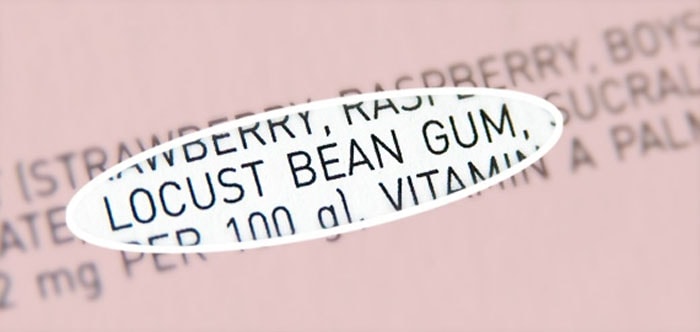
If you are a label reader, you will find that many low-fat or fat-free versions of your favorite food products contain multiple fat replacers. Because the real fat has been removed from the product, manufacturers have to use other ingredients in place of fat. What are these ingredients and what exactly do they do?
Table of Contents
Modified starch can be obtained from corn, tapioca, wheat, or other sources. The starch is treated in some way to change its original properties. Typically the resulting modified starch is used to thicken, stabilize, or help ingredients blend better in a product. You can often find modified starch in prepackaged low-fat or fat-free salad dressing, yogurt, ready-made sauces, and gravies.
As a label reader, you must have come across at least one or a few of these food gums: gum arabic, xanthan gum, guar gum, carob bean gum, or locust bean gum. There are also several gums that don’t include the word “gum” in their names, such as carrageenan, cellulose, agar-agar, and alginate. Most gums are used as thickeners or stabilizers, or to provide a creamy mouth feel. Some have better heat resistance than others, while some can better tolerate lower pH and therefore can be used in acidic products such as salad dressings. A wide range of products uses food gums, such as pudding, yogurt, ready-made frosting, processed meats, ice cream, ready-made sauces or gravies, and frozen entrees. Carrageenan is prevalent in many non-dairy alternative beverages, such as soy milk and nut milk. In recent years, the safety of carrageenan as a food additive has been questioned because there are concerns that it may induce inflammation in susceptible individuals.
One of the side effects of having food gums added is the increase in the fiber content of the food. Therefore, you may see claims that are a bit odd, such as yogurt that advertises itself as “a source of fiber.” If you really want fiber, eat fresh vegetables, fruits, and whole grains instead. Don’t rely on added fiber in processed foods.
Gelatin is an animal-source food additive typically obtained from collagen derived from various animal (usually beef or pig) byproducts. Gelatin in low-fat or fat-free products helps simulate the creamy mouth feel of fat without adding calories. It can also be used as an emulsifier, thickener, or texturizer.
These are emulsifiers found in an extensive list of products including commercial baked goods, granola bars, whipped cream products, ice cream, and shortening. The concern about this additive is that the production of mono- or diglycerides may result in the formation of harmful trans fats, yet the label may claim the product to be “trans fat free” because the labeling law only requires that manufacturers report trans fat levels of lipids. Mono- and diglycerides are classified as emulsifiers and therefore are exempt from the labeling requirement.
If you think that low fat means low calories, read on. Often, reduced fat items have more sugar added to enhance the flavor, which contributes calories to the final product. Also, many of us think that by eating the low fat version of a food, we can eat more of it. If you are watching your weight, this will only sabotage your efforts.
Check out the list of foods below to see the difference in calories (if there is any) between common low fat and regular fat foods.
|
Low-fat or Fat-free
|
Regular
|
|||
Reduced Fat Peanut Butter
|
Regular Peanut Butter
|
|||
Low Fat Wheat Thins
|
Regular Wheat Thins
|
|||
Low Fat Oreos
|
Original Oreos
|
|||
Fat Free Fig Newtons
|
Regular Fig Newtons
|
|||
Low fat Fruit-flavored Yogurt
|
Regular Fruit-flavored Yogurt
|
|||
Low fat Granola Cereal
|
Regular Granola Cereal
|
|||
Light Tortilla Chips
|
Regular Tortilla Chips
|
|||
Fat Free Apple Cinnamon Muffin
|
Regular Apple Cinnamon Muffin
|
|||
Although it is a good idea to limit your fat intake, you can see that sometimes there is not much of a calorie difference between the low fat (or fat free) version of a food compared to its regular version. So, what are you to do? If you like the taste of a particular higher fat food, limit your calories by controlling your portion. If you think that eating low fat or fat free foods permits you to eat more of a specific food, think again!
The prevalence of low-fat or fat-free products is partly the result of a collective fat phobia; fat is perceived as “evil” because of its high caloric density (9 kcal per g). However, fat has multiple functions in food. It is a carrier of fat-soluble vitamins. It also helps the bioavailability of some phytonutrients, provides the creamy mouthfeel of many desserts and sauces, and is the carrier of many pleasant flavor compounds that increase the palatability of the foods we eat. In wheat-based baked goods, fat helps interrupt gluten formation and therefore helps certain products attain a softer, flaky texture (such as pie crust). Our bodies actually need fat (albeit the right kinds of fat) to function.
Many fat replacers are not rigorously studied for safety. If you were to ask us, when faced with the choice between full-fat or fat-free, we would say go for the real thing. Just be aware of the high caloric density of a full-fat product, and use occasionally in a reasonable amount. If you look at the list of fat replacers above, while the calories may be reduced by the removal of fat, what has been added back in isn’t exactly spectacular. As an example, with modified food starch, naturally occurring fat is removed in favor of more processed carbohydrates in the final product.
Alumni: University of California, Berkeley – Sofia believes in bringing back fun and pleasure into everyday eating. She loves cooking, and is constantly experimenting with ingredients, creating recipes and trying them out on family and friends. Her latest interest lies in finding realistic and practical ways of environmentally-friendly food/eating habits.
carrageenan, emulsifier, fat free, gelatin, grocery aisle, gum, lose that weight, low fat, modified starch, thickeners
Like our content? Download our free shopping guide and the first chapter of the GoUndiet Book Now!


HealthCastle Nutrition Inc. · © Copyright 1997-2026 · All rights reserved

I would just like to say that I am a ceoliac and I have found that gluten fee foods have been upsetting my tummy for a long time and discovered that xamham gum have been the problem, also other thickners, colouring, additives, just found that fat free milk, semi skimmed milk have caused me problems changed to whole milk and whole plain yogurt and am a lot better. Just keep on completely fresh foods, this is as short story I can say as this has been going on a long time and I feel now as if I am getting somewhere now. Daphne