
Written By: Gloria Tsang, RD
Title: Founding Registered Dietitian
Alumni: University of British Columbia
Published on:

The Dietary Guidelines for Americans have returned to a familiar visual. The food pyramid is back, now inverted. Protein, dairy, and healthy fats appear at the top, alongside vegetables and fruit. Whole grains are narrowed to the base. The message is simple: eat real food (https://realfood.gov).
As a registered dietitian, I welcome parts of this shift. Protein has long been underemphasized in public nutrition guidance, particularly for older adults, active individuals, and people managing metabolic health. At the same time, what this pyramid shows, how foods are grouped, and what is missing altogether deserve closer scrutiny, especially for a diverse readership.
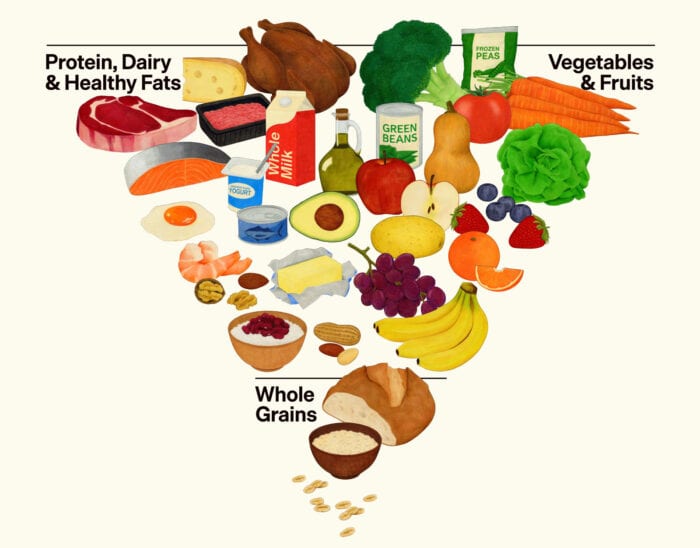
Table of Contents
One of the most significant updates is the emphasis on higher protein intake. The guidance associated with the new pyramid promotes roughly 1.2 to 1.6 grams of protein per kilogram of body weight per day, compared with the older benchmark of 0.8 g/kg that was designed to prevent deficiency rather than optimize health, according to the appendix.
This shift aligns with evidence showing that adequate protein supports muscle maintenance with aging, recovery from illness, immune function, and appetite regulation. Many adults, particularly those over 50, do not consistently meet optimal protein intake. From this perspective, the new pyramid corrects a long-standing imbalance. However, while an intake of 0.8 g of protein per kg of body weight may not meet everyone’s needs, eating 1.6 g is not appropriate for everyone either.
The framework also discourages ultra-processed foods and excess added sugars, which reflects strong evidence linking highly processed diets with poorer cardiometabolic outcomes.1 These elements move public guidance in a healthier direction.
One of the most consequential design choices is the grouping of Protein, Dairy, and Healthy Fats into a single category at the top of the pyramid. This is a departure from previous USDA models, which separated these food groups.
Visually, grouping them suggests equivalence. Nutritionally, they are not interchangeable. Protein has defined intake targets tied to body weight and health outcomes. Fats vary widely in their effects on cardiovascular risk. Dairy provides protein and micronutrients, but also saturated fat and lactose, which are not appropriate for everyone.
For individuals managing heart disease, lipid disorders, insulin resistance, or chronic kidney disease, these distinctions matter. Visual guidance shapes perception and behavior, often more powerfully than written explanations. When categories blur, nuance is easily lost.
Perhaps the most striking issue with the new pyramid is what is not clearly shown. Beans and legumes, long recognized as cornerstone protein sources, are barely visible or entirely absent.
There is no labeled legume category. Lentils, chickpeas, tofu, edamame, and soy-based foods do not appear in the image. A small bowl at the bottom of the protein group could contain beans, but it is visually ambiguous and unlabeled. Peas appear only as vegetables. Nuts are present, but in small amounts (one piece each) and without clear framing as protein equivalents.
This omission matters. Beans and legumes are not fringe foods. They are staple protein sources across many cultures and dietary patterns. Decades of research associate regular legume intake with improved cardiovascular outcomes, better glycemic control, and reduced risk of chronic diseases.2
Clinical reviews show that replacing some animal protein with legumes3 can lower LDL cholesterol and improve metabolic markers, particularly in people with type 2 diabetes and cardiovascular risk. Legumes also contribute meaningful amounts of dietary fiber, a nutrient most Americans do not consume enough of.
Yet the pyramid’s visual hierarchy tells a different story. Animal proteins are immediately recognizable and prominent. Without equally visible plant-based counterparts, the image frames animal foods as the default interpretation of real protein.
National dietary guidance must balance simplicity with inclusivity. The new inverted pyramid succeeds in elevating protein and moving away from a grain-dominated model. It also reinforces the importance of whole foods and limits on ultra-processed products.
But a framework meant to serve a diverse public cannot afford to marginalize core foods. Protein comes in many forms; beans, lentils, and soy products are not secondary options. They are central to healthy eating patterns worldwide and supported by strong evidence. Until then, the new pyramid represents progress, but not completion.
HealthCastle has strict sourcing guidelines. We reference peer-reviewed studies, scientific journals and associations. We only use quality, credible sources to ensure content accuracy and integrity.
Alumni: University of British Columbia – Gloria Tsang is the author of 6 books and the founder of HealthCastle.com, the largest online nutrition network run by registered dietitians. Her work has appeared in major national publications, and she is a regularly featured nutrition expert for media outlets across the country. The Huffington Post named her one of its Top 20 Nutrition Experts on Twitter. Gloria’s articles have appeared on various media such as Reuters, NBC & ABC affiliates, The Chicago Sun-Times, Reader’s Digest Canada, iVillage and USA Today.
Latest Research: Quantity Not Key, Whole Food Diet Helps You Eat More, Consume Fewer Calories
Is Orange Juice Actually Good for You? A Concise Nutritional Science Review
Like our content? Download our free shopping guide and the first chapter of the GoUndiet Book Now!


HealthCastle Nutrition Inc. · © Copyright 1997-2026 · All rights reserved