
Written By: Keeley Drotz, RD
Title: Registered Dietitian
Alumni: Seattle Pacific University
Last Updated on:

Although a baby’s diet is rather limited during the first year, baby food – both homemade and store-bought – has the potential to carry germs that cause illness. Thus, precautions must be taken during preparation and storage to ensure your baby’s food is safe to eat.
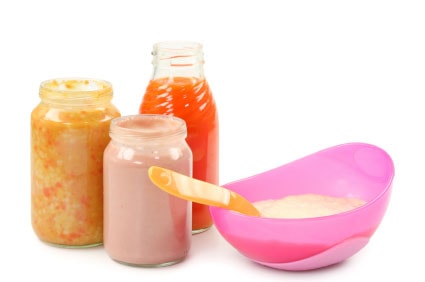
Table of Contents
Wash your hands thoroughly with hot, soapy water prior to preparing or serving baby food. Use hot, soapy water to wash all utensils (including the can opener) and dishes that are used for your baby’s food; rinse well with hot water and air dry (or use a dishwasher). Thaw frozen baby food, covered, in the refrigerator overnight; never thaw it at room temperature.
Saliva on your baby’s spoon may introduce germs into the food he or she is eating. These germs can multiply if the food is saved in the refrigerator for a future feeding. Therefore, it’s best to avoid feeding your baby directly out of the baby food jar or container. Rather, put one serving into a dish and place the jar/container of food back in the refrigerator. Discard any food left in the dish after your baby has eaten – don’t re-use leftovers.
Always store baby food in a covered or sealed container.
|
Refrigerator
|
Freezer
|
|
| Cooked Fruits and Vegetables |
2 to 3 days
|
1 to 3 months |
| Meat/Fish/Poultry and Egg Yolks | 1 day | 1 to 2 months |
| Meat and Vegetable Combinations | 1 to 2 days | 1 to 2 months |
Baby food should always be transported in an insulated container with frozen ice packs. Throw out any food that goes without refrigeration or ice packs for more than 2 hours. Never store dirty diapers and baby food (including unopened) in the same compartment of your diaper bag. Germs from a dirty diaper (even if wrapped up well) could contaminate the baby food.
Your infant’s health is of utmost importance. It is worth whatever effort it takes to make sure your baby’s food is safe and free of germs.
Alumni: Seattle Pacific University – Keeley graduated Summa Cum Laude from Seattle Pacific University with a Bachelor of Science in Food and Nutrition and a Dietetics Specialization. She went on to complete her dietetic internship at Baylor University Medical Center in Dallas, where she received the Distinguished Dietetic Intern Award and Scholarship.
baby, baby food, food safety, kid's nutrition
Cooking with Kids – What You Should Know
When “Zero” Isn’t Really Zero: How to Spot Trans Fat in Foods
Like our content? Download our free shopping guide and the first chapter of the GoUndiet Book Now!
HealthCastle Nutrition Inc. · © Copyright 1997-2026 · All rights reserved