

Written By: Gloria Tsang, RD
Title: Founding Dietitian
Alumni: University of British Columbia
Last Updated on:

All manufacturers claim their own cooking oil is the best! Canola oil, olive oil, avocado oil, sunflower oil, butter, and virgin coconut oil all have their supporters. I’m often asked to compare cooking oils. Every time I speak about nutrition in public, the question about the best cooking oil for home use is brought up. So, I decided to put them all on a chart, for easy comparison.
Table of Contents
My answer is that all home cooking oils are about the same; they all provide about 120 calories per tablespoon. Unless you drink your cooking oil, or deep-fry every day, your choice of cooking oil doesn’t make a huge difference. It’s good that we pay attention to our oil. But the fact is, the major source of oil in our diets isn’t home cooking – it’s packaged foods and fast-food meals!
Before we conclude which are the best cooking oils, let’s look at the essentials – Fats 101. We’ve been classifying fats into the good and the bad categories for years. They were classified based on their heart-smart values: their ability to raise or lower total and LDL cholesterol. The problem is, some fatty acids are neither – they don’t raise or lower cholesterol. Instead, their effect on cholesterol is neutral. In my book Go UnDiet, I discuss why some “bad” saturated fatty acids, like stearic acid, are not as bad as we thought. On the other hand, some “good” polyunsaturated fatty acids, like omega-6, are not as good as we might hope.
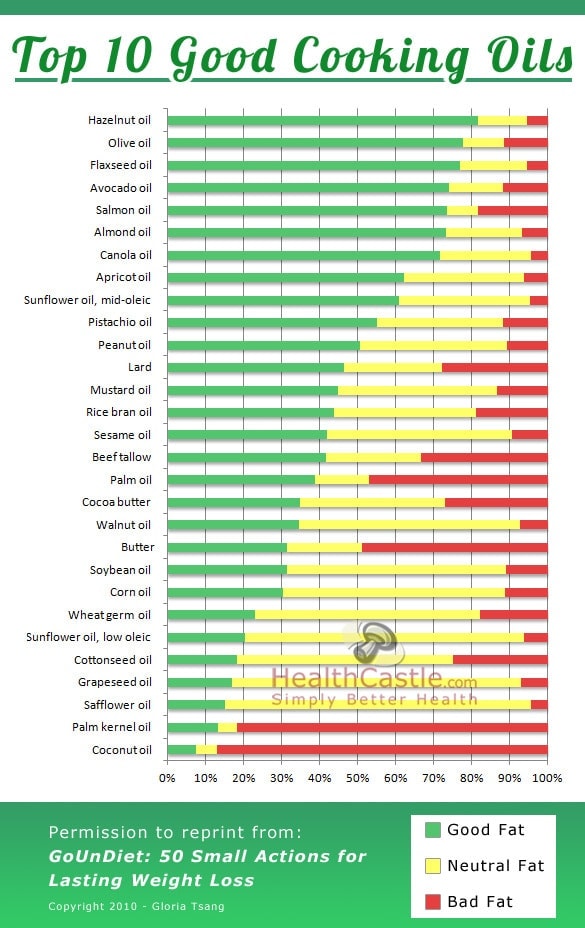
Based on the above classification, the “ideal” cooking oil should contain the highest amount of the “good” fats (omega-3 and 9), and minimal saturated fats and trans fats. All of the following cooking oils are low in the “bad” fats as well.
If you’re concerned about GMO, it’s likely that corn, soy, and canola oils are genetically-modified. There’re non-GMO, organic kinds of these oils available. So check the label.
Extra notes: Choose sunflower oil or canola oil if you wish to fry foods, as these oils have a higher smoke point. It is best not to fry with extra-virgin olive oil, as its smoke point is only about 190C/375F.
Tell Us: Which cooking oil(s) do you use at home?
Alumni: University of British Columbia – Gloria Tsang is the author of 6 books and the founder of HealthCastle.com, the largest online nutrition network run by dietitians. Her work has appeared in major national publications, and she is a regularly featured nutrition expert for media outlets across the country. The Huffington Post named her one of its Top 20 Nutrition Experts on Twitter. Gloria’s articles have appeared on various media such as Reuters, NBC & ABC affiliates, The Chicago Sun-Times, Reader’s Digest Canada, iVillage and USA Today.
best oil for cooking, coconut oil, grocery aisle, healthiest cooking oil, heart smart, olive oil, omega-3
Like our content? Download our free shopping guide and the first chapter of the GoUndiet Book Now!


HealthCastle Nutrition Inc. · © Copyright 1997-2026 · All rights reserved


This chart is very helpful! Is there a printable version available?
you can take a screenshot and print I guess using snipping tool
No mention about the oxidization of these vegetable oils which are obviously bad for cooking, the fact that the source plant is good doesn’t mean cooking at high temps with its oil -some of them highly processed btw- is good.
Hi Gloria
This is a very informative article and the colour chart for the oils is a very practical tool. Do I have your permission to share?
Recent studies show that excessive consumption of the Omega 6 fatty acid triggers the body to release pro inflammatory chemicals that cause many cardiovascular diseases.
just by seeing seed oils being placed at the top of the list I can already tell that this is some bs…
I don’t mean to be rude, but before putting out something like this you should make some meaningful research, don’t just throw it in there.
I just get mad about people constantly being misinformed.
Best cooking oils – and the only ones you should use – are ghee, beef tallow, butter and coconut oil. That should be it. You could use some high quality avocado oil and some Extra Virgin Olive Oil too if you just cook at low temperature but I don’t recommend it.
Just do some research and realize the damage seed oils are doing, especially refined seed oils.
You will quickly realize how bad they’re for our health.