
Nutrition Basics 101Healthy Eating GuidelinesSuper FoodsHealth and NutritionWomen's NutritionWeightloss DietNutrition Newsletter

Be Smart - Understanding Food Labels and Nutrition Facts

Written by Patty Poon, M.Sc.
last updated: May 2006

Grocery shopping and reading labels are a delight for some and a real headache for others. Regardless of how you feel about them, determining whether a particular food product fits into your healthy diet plan has become easier. In addition to listing the amounts of macronutrients (fat, protein and carbohydrate including fiber), a food label may also indicate vitamin and mineral content of the product. This provides good information to help a consumer determine if a particular food product meet his or her nutritional needs.

What is on A Nutrition Facts Label?nutrition facts food label

Food labels are designed to help consumers make healthy food choices. In 1990, the Nutrition Labeling and Education Act went into effect. The USDA and the FDA developed these guidelines so that consumers would have access to useful nutritional information to help make smart choices.

But how do you make sense of a food label?

According to the Nutrition Labeling and Education Act, all packaged food products must contain the following information:

  • Common name of the product
  • Name and address of the product's manufacturer
  • Net contents in terms of weight, measure or count, and
  • Ingredient list and Nutrition Facts


Components of a Nutrition Facts panel

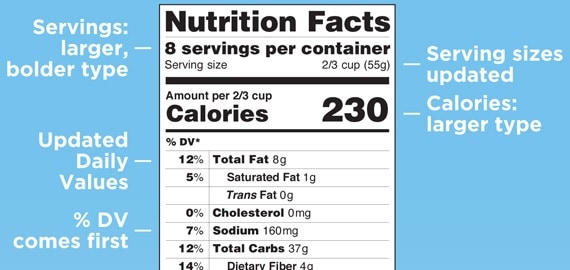
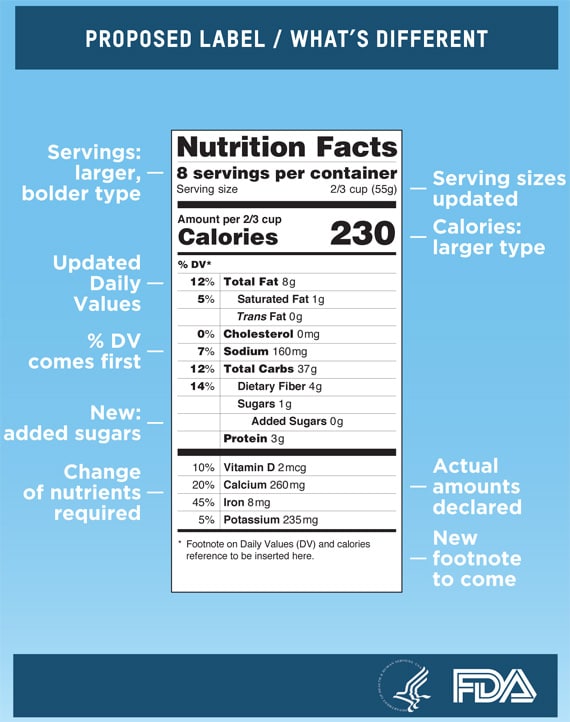
Nutrition Facts

Common nutrients, such as total fat, cholesterol, and sodium, are required fields. Other nutrients, such as potassium and Vitamin K, are optional and not required to be listed. Each package must identify the quantities of specified nutrients and food constituents for one serving. It is important to note the following:

  • 1 g of fat = 9 kcal
  • 1 g of protein = 4 kcal
  • 1 g of carbohydrate = 4 kcal
  • 1 g of alcohol = 7 kcal

Serving Size

Serving sizes are standardized to make for easier comparison among similar food items. They are expressed in both common household and metric measures. It is always important to pay attention to a serving size. For instance, a serving of chocolate chip cookies is typically 2 pieces. Hence, if you eat 4 pieces, you will need to double the amount of nutrition content listed on the label.

Calories (kcal)

Calories provide a measure of how much energy you obtain after eating a portion of food. It is always important to find out the total calories. Many consumers are surprised to find that a fat-free product is not necessarily low in calories. Similarly, a sugar-free product is not always low in Calories or low in fat.

Nutrients listed

Total fat, saturated fats, cholesterol, total carbohydrate (including fiber and added sugars), protein, vitamins A and C, calcium and iron are required on the label. Other nutrients are optional and may be listed at the discretion of the manufacturer.

In addition to total calories and total fat, a few other nutrients relevant to heart health are important to pay attention to when reading a label. These include saturated fats, cholesterol and fiber. Effective Jan 2006, all labels should also include trans fatty acids.

Percent Daily Values

Percent Daily Values provide an estimate of the percentage of a nutrient from one serving in a typical 2000 kcal diet.

Daily Reference Values Footnote

This footnote reminds consumers of the daily intake of different foods depending on their own nutritional needs.

nutrition facts food labelReading Food Labels - the Bottom Line: Food Labels and Nutrition Facts enable you to compare products based on key ingredients. When comparing products, focus on those nutrients that are important to you.

  • If you are concerned about your weight, you should compare products based on BOTH calories and fat.
  • If you have heart disease or high blood pressure, you should focus on the amount of total fat, saturated fat, trans fat, cholesterol and sodium. Choose products containing less than 20% Daily Values for fat, cholesterol and sodium.
  • If you have diabetes, you should pay attention to the amount of carbohydrate, sugar added as well as fiber.

nutrition facts food labelFurther Reading:

Page copy protected against web site content infringement by Copyscape


| Print Page | | nutrition tips |

Want to discuss nutrition topics? Use our Discussion Forum


Advertisement

FAQ Editor's Picks

If you want a bigger, better relationship with a slimmer partner, learn how to stop criticizing and start caring.

Food & Nutrition

Diet Guidelines
Nutrition Basics
Grocery Aisle
Healthy Dine-out
Super Foods
Nutrition Books
Nutrition Articles

Nutrition & Health

Heart Smart Diet
Cancer Diet
Gout Diet
Acid Reflux
High Cholesterol
Diabetes Diet
Diverticulitis Diet
Lactose Intolerance
IBD Diet
ADHD Diet

Women's Nutrition

Menopause Diet
Osteoporosis
Anemia
Breast Cancer Diet
Pregnancy Nutrition

Weight Loss Nutrition

Am I Overweight?
Free Diet Profile
BMI Calculator
Waist-to-Hip Ratio


HONcode accreditation seal.
Categories:
Nutrition 101 | Healthy Eating | Super Foods | Podcast | Women's Nutrition | Food & Nutrition | Nutrition & Health | Weight & Diet
Member Area:
Login | SignUp | Free Nutrition Newsletter | Forum | Search | healthcastle nutrition
Media:
Press Room | Gloria Tsang, RD | In the News | News Release | White Paper | Logo | Recommended By | Event Photos
Corporate:

About Us | Advertise with Us | Legal | Career | Syndicate | Privacy Policy | Site Map | Contact Us

Information on this site is provided for informational purposes and is not meant to substitute for the advice provided by your own physician or dietitian. Information and statements have not been evaluated by the Food and Drug Administration and are not intended to diagnose, treat, cure, or prevent any disease.
Copyright© 1997-2008 Healthcastle Nutrition Inc. All rights reserved.